| Lectures |
Books |
Bio/Contact |
|
Lectures & Workshops |
Color! Color! Color! (lecture)
This fast-paced lecture begins with a look at the three color characteristics common to all quilts and garments: value, temperature, and intensity. These terms sound academic, yet they, as much as color itself, are the key to making great quilts. Learn how to use the color wheel to create fresh, unexpected color combinations. Slides of quilts from nationally known quilters are followed by my quilts and a mini fashion show of my garments.
One hour. Slides, color wheel, quilts, and garments. Fee: $400.
Color for
Your Home (lecture)
Based on the
Sunset book, Color for Your Home.
Color is color, but it certainly behaves differently in a room than in a quilt! This lecture begins with a slide show that illustrates the basic color concepts of value, temperature, and intensity in room settings. Next, I offer strategies for building a color plan, from assessing your givens to "auditioning" paint, fabric, and flooring in a room. I bring lots of examples of resource materials, and there's plenty of time at the end for your decorating questions.
1 1/2 hours. Slides, color wheel, and decorating samples. Fee: $400.
Color! Color! Color! (workshop)
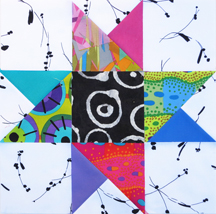
"You can do color!" is the premise of this one-day, no-sew workshop that combines short lecture segments with hands-on exercises. We begin with a discussion of color characteristics and the color wheel, then play with ways to create successful color schemes. Students put the theory into practice making four 9-inch mock blocks (cut and paste) based on these classic block patterns: Double Four Patch, Variable Star, Churn Dash, and Connecticut. (Speedy students often do more than four mock blocks.) We'll critique the blocks after each exercise, giving everyone the opportunity to see what works, what doesn't, and, just as important, why.
Learn to:
- use value (light and dark), temperature (warm and cool), and intensity (bright and dull) in your block designs
- create classic color combinations (analogous, complementary, triadic, to name a few) using the color wheel
- achieve the special effects of luminosity and transparency
- go beyond "safe" color palettes
- solve common color problems and turn so-so blocks into great ones
Six hours. Lecture, discussion, exercises, and critique; sample blocks, quilts, and garments. I provide a "library" of fabrics, arranged by color, for students to dip into for the exercises. Fee: $600.
Color! Color! Color! (supply list)
- Color: The Quilter's Guide (optional; used copies usually available on amazon.com)
- Rotary cutter, ruler, and mat
- Glue stick (Make sure it's fresh.)
- Fabric
To create the most pleasing color studies, you'll need a wide variety of fabrics in different colors, values, intensities, and patterns. Bring 1/4 yd. or larger cuts. If you bring scraps, each should be at least 9" x 9".
Bring beautiful fabric! Shop if necessary to have a good selection of great fabrics - you'll have much more fun and success with outstanding fabrics than with ordinary ones. (This is not the time to "use up" fabric you don't like.) I suggest that you work with all-over prints and near-prints (tone-on-tone) rather than plain solids. Avoid high-contrast patterns, though; they can look chaotic when cut up. I use many mottled or dappled fabrics, especially hand-dyed fabrics and batiks, because they add depth and luminosity to a quilt.
"Intensity" refers to the brilliance of a color. Try to include both intense (bright) and low-intensity (not-as-bright) fabrics. It's also very important to have a good mix of "values" (lights, mediums, and darks) in colors from all around the color wheel. Most of us have plenty of mediums and darks; lights are harder to come by. Don't go to extremes however; very light or very dark fabrics are difficult to make work.
There are twelve colors on the color wheel. Following is a list of the colors, with just a few common names in parentheses to help you visualize what they look like. (In reality, there are many versions of each color.) Try to bring at least one light, medium, and dark for each color, but don't worry if you can't.
- Yellow (daffodil, straw)
- Yellow-green (olive, apple green)
- Green (true green, mint)
- Blue-green (turquoise, teal)
- Blue (true blue, slate)
- Blue-violet (periwinkle, iris)
- Violet (purple, eggplant)
- Red-violet (magenta, fuchsia)
- Red (primary red, brick)
- Red-orange (terra cotta, salmon)
- Orange (pumpkin, spice)
- Yellow-orange (mango, cheddar)
Organize your fabrics by color. Be sure to come to class 15 minutes early to set up. We start right on time!
The key to happiness in making this sweatshirt jacket is using the right fabrics for your sweatshirt. The class begins with a group evaluation of each student's fabrics to learn what will work, what won't, and why. (You should bring more than the number of fabrics indicated, to have a broad selection to choose from.) Once you settle on the fabrics, you'll cut an assortment of bias strips, glue-baste them to the sweatshirt foundation, and stitch close to the raw edges of each strip. You'll then surface-stitch your sweatshirt as much or as little as you like. Before the class ends, I'll show you how to make the chenille circles and attach the rick-rack and binding. It's fast; it's fun; it's colorful. (I'll have the rick-rack, from Rainbow Resource, available at the time of the class; see below.) See Gallery.
Six hours. Fee: $500.Supply List
Note: Do not prewash your sweatshirt or your fabrics. Do remove the ribbing on the sweatshirt, and take it apart at the side and underarm seams so you can lay it flat.
- Sweatshirt two sizes larger than your desired finished size. Make sure it has standard, not raglan, sleeves. I prefer an 80/20-cotton/poly blend, or a similar ratio of cotton to poly.
- Twelve fabrics (at least) roughly similar in value (lightness or darkness) to your sweatshirt. You want the fabrics to "read" as separate strips, yet not jump out from the sweatshirt. Avoid batiks or other tightly woven fabrics for the circles; they don't "ruffle" enough to create chenille.
I used a few stripes and one batik, but most of the fabrics were Kaffe Fassett fat quarters, each of which will yield at least one 25-inch-long bias strip, enough length to go all the way down the front of my sweatshirt. I had to "piece" other strips, placing their angled ends a bit apart on the sweatshirt. The shorter strips are perfect for the sleeves. You'll need ¾ yard of fabric for the bias binding (plan to use this fabric for the chenille circles and sweatshirt strips, too).- Rotary equipment. A 24- by 36-inch mat and 6- by 24-inch ruler make easy work of cutting the bias strips.
- Basting glue. I used Roxanne's Glue-Baste-It!
- A walking foot is very helpful. If you don't have one, you'll need to pin the strips securely before stitching.
- Plates or circle templates to cut the chenille circles. (My small circles are 5 inches, the large ones 9 inches.)
- All-cotton thread to blend with your fabrics and sweatshirt. You'll need several standard-size spools (they can be different colors) or one large spool.
- Scissors or chenille cutting tool
- Monofilament thread for attaching the rick-rack.
- Rick-rack or other trim. I used a wonderful ½-inch hand-dyed rick-rack ($3.50/yd.) from Charlene Younker of Rainbow Resource, (707) 937-0431, rainbow@mcn.org.
In & Out Quilt (workshop)
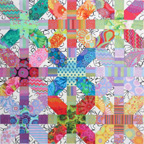
This graphic quilt is composed of 25 blocks, each containing four quarter-units made from a variety of stripes, batiks, and hand-dyes. (Students can use any combination of fabrics that contrast, such as lights and darks.) The method for making the units is surprisingly simple, and yields two delightfully different effects ("in" and "out") from the pairings of two fabrics. The workshop begins with a crash course in color, followed by step-by-step directions for making the units and the blocks. See Gallery.
Six hours. Fee: $600.
Transparency (workshop)
Amaze your family! Fool your friends! They will be impressed when you show them a block or quilt that incorporates the illusion of transparent color. In this special effect, one color appears to lie over another, and where the two colors overlap, a third color is formed. It takes "just-right" fabrics for successful transparencies, but when it works, wow! We start with a crash course in color, then work three simple blocks, followed by three more challenging ones.
Six hours. Mini-lecture, exercises, critique, sample blocks. Fee: $600.Transparency (supply list)
This is a cut-and-paste, no-sew class. I provide the mock-block handouts, plus a mini color wheel for reference. (If you have a color wheel you like, bring it.) You'll also need:
- a fresh glue stick
- rotary ruler, cutter, and mat
- fabrics
Bring a range of values for each of the twelve colors on the color wheel: for example, a light, medium, and dark fabric in yellow-green, blue-violet, red, etc. (Avoid very pale fabrics; they read as white.) You'll be creating transparencies that mix both value and color, so a broad range of fabrics is a must.
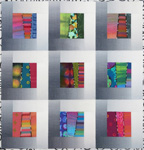
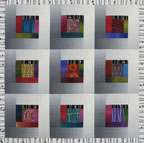
Also bring fabrics that contain several colors, such as the center fabric in the Nine Patch block shown here; this is the "mixed" color. To use a fabric like this, you'll need fabrics that look like the logical "sources" of the mixed color, such as the blue-green dot and the yellow batik in the outer squares of this block.
After we do three Nine Patch exercises, you'll do one of three other block designs. These are more challenging, but they have the potential to make a fantastic quilt. The second block shown here, "Connecticut," looks complicated but is surprisingly easy to achieve once you understand the concept. Click images for larger views.
Hint: Fabrics that are mottled or "shot with light" are wonderful for creating transparencies. Batiks and hand-dyes have the most potential, but any fabric that has the sensation of light coming from behind has possibilities.
Fabric collage and surface stitching combine to create a sophisticated vest that makes the most of color, pattern, and texture. The workshop begins with examples of harmonious (but not matching) fabrics for collage. Then the fun begins: you'll develop your composition on your foundation fabric, then pin the pieces and anchor the raw edges. I'll demonstrate surface stitching and go over the how-tos of finishing. My Kimono Collage Vest pattern will be available in class, or bring your own favorite pattern.
Six hours. Fee: $600.Collage Vest (supply list)
- Sewing machine
- Vest pattern
- Foundation fabric
You'll need enough to cut out your vest front and back pieces plus 1/3 yard. (You must cut the foundation pieces with an extra 1 1/2-2 inches on each edge.) Choose a fabric you like a lot because it becomes the inside of your vest. If you plan to buy my pattern, you'll need fabric to total approximately twice the measurement from the high point on your shoulder to your hip bone, plus the 1/3 yard.
- Collage fabric
- 1/3 yard of main fabric
- 1/4 yard of 8 to 10 other fabrics
- 1/4 yard of fabric for binding (can be your main fabric). For bias binding, 3/4 yard or more is best.
- scraps of 4 to 6 accent fabrics
- Rotary equipment
- Scissors
- Pleating pins. These are shorter and thinner than regular pins and are ideal for pinning your collage pieces to the foundation.
- All-cotton neutral thread that blends with your fabrics to stitch the collage pieces to the foundation. You don't want this thread to show; a medium gray or beige usually works.
- All-cotton thread in a variety of colors for the surface stitching. For one vest, I usually use five or six spools of thread.
Hint: Choose fabrics that contrast with each other. They may have a common color or a similar "feel," but if they are over-coordinated in color, your vest will look like one piece of fabric (and you will be disappointed!). Surface stitching has a tendency to blend and blur the differences, so when in doubt, opt for fabrics with more, rather than less, contrast in:
- pattern scale (size of the motifs in the pattern; include small-, medium-, and large-scale fabrics)
- value (some light, some medium, some dark fabrics)
- temperature (some warm, some cool fabrics)
- pattern density (some open, some dense fabrics)
For your accent scraps, choose fabrics with more intense color.
Modular Color Blocks (workshop)
A takeoff on the traditional Log Cabin block, this foundation-pieced block is a simple and rewarding vehicle for exploring color. (See Modular Color Blocks.) Learn about value (light and dark), temperature (warm and cool), intensity (bright and dull) and ways to use the color wheel for winning combinations. In this workshop you'll make at least two blocks, more if you are speedy. I provide you with a master paper pattern for a 12-inch block, which you'll trace onto your muslin square.
Six hours. Fee: $550.Corral Log Cabin (supply list)
- #2 pencil and a good sharpener
- Two (or more) squares, 14 by 14 inches, of preshrunk, lightweight muslin*
- Rotary ruler, cutter, and mat (at least 11 by 17 inches; larger is preferable)
- Pins
- Fabric scissors
- Sewing machine with neutral-colored thread
- Color wheel (optional)
- Fabric**
*Preshrink your muslin; if you don't, steam from the iron may shrink and distort your block. Also, make sure you can see pencil lines through your muslin.
**Bring a wide variety of fabrics in colors all around the color wheel. Bring fabrics you love, and when in doubt, bring more! It's essential that your fabrics vary in value, from light to medium to dark, to make the corral design "read." For a calm, cohesive look, stick with one fabric mood or style; if you're brave, mix wildly different fabrics. My blocks followed a "recipe": a light batik center framed by a dot, surrounded by a stripe, and completed with a medium-light batik.